
Commissioning a research report is not just about hiring a researcher to find data – it’s about ensuring the final output directly addresses your business needs. Too often, companies end up with a polished report full of charts and data. It may look impressive, but it fails to answer the specific business question that prompted the research. This outcome usually stems from an unclear brief or poorly defined objectives at the start.
To avoid receiving a “pretty document” that you can’t use, you need to plan the project with intentional focus. In practice, that means writing a clear brief and setting decision-focused objectives. It also involves defining what a successful report should deliver from the outset (IFF Research, 2026; FieldworkHub, 2025).
Write a focused research brief
Every successful research project begins with a well-thought-out brief. A research brief is a document in which you explain the background to your business problem and the objectives of the study. It also outlines the practical details of what you need (FieldworkHub, 2025).
A good brief creates alignment between you (the client) and the researchers from the very start. It clarifies what the research is there to achieve and helps the researchers propose the best approach. It also prevents misunderstandings that could lead to delays or extra costs. By contrast, a vague or incomplete brief can send a project off track. Objectives can quickly become blurred and the methodology might miss the mark. Ultimately, everyone ends up frustrated. In short, the brief can make or break the project. It is often the difference between research that simply “ticks a box” and research that delivers real impact (FieldworkHub, 2025).
What should your brief include? Ensure it covers all the essential elements needed to guide the researchers. These typically include:
Background and context:
Explain the business challenge or opportunity that led you to commission the research. Provide any relevant industry or company context.
Objectives and questions:
State clearly the core business question(s) you need answered. Outline the key research objectives (what you want to find out) in a focused way.
Target audience or sample:
Define who or what the research will cover. For example, specify the customer segments, markets, or product lines of interest.
Constraints and parameters:
Note any practical constraints such as budget limits or timelines (for instance, any internal deadlines for results). Also include any specific requirements, like geographic scope or data format.
Preferred approach (if any):
If you have any ideas about methodology (e.g. surveys, interviews) or certain methods to avoid, mention them. However, you can also ask the agency to recommend the best approach.
Expected deliverables:
Describe what form of output you expect – for example, a written report, a slide presentation, or a workshop briefing. Be sure to note any preferences on the format or length.
Stakeholder considerations:
Identify who in your organisation will use the results. Note if they have any particular expectations – for instance, an executive summary for senior leaders.
It’s often useful to discuss the brief with your internal stakeholders before finalising it. These colleagues will ultimately act on the findings, so their input is valuable.
Remember that investing time upfront in a thorough brief will save you time later. It also increases the chances of getting truly valuable results. Spending the effort to write a good brief is “time well spent”. After all, a poor brief can lead to findings that fail to meet your true objectives, wasting time and money.
Set decision-focused objectives
Defining clear research objectives is one of the most important steps in commissioning a useful report. Your objectives should be decision-focused. In other words, each one should link directly to a business decision you need to make.
One effective approach is to distinguish between research objectives and business objectives. The research objectives are the specific things you want to learn or measure. The business objectives, on the other hand, describe what you plan to do once you have those answers. For example, one research objective might be “to measure overall customer satisfaction with our product.” The corresponding business objective could then be “to use that feedback to improve specific aspects of the customer experience in the next quarter.” (Australian Survey Research, 2021). By pairing each research goal with a clear business goal, you ensure that every question you ask has a purpose.
When formulating objectives, a good test is to ask yourself, “What would we do differently if we knew this?” (Australian Survey Research, 2021). If you cannot answer that question – or if the honest answer is “nothing” – then that topic is likely just nice-to-know rather than need-to-know. In that case, it may not be worth including in the project. Prioritise objectives that will drive decisions or actions.
In practice, most projects benefit from having a handful of well-defined primary objectives rather than a long wish-list. Aim to set only three or four main goals for the project. These overarching aims should capture what the project ultimately needs to achieve. Keeping the list of objectives short and focused helps prevent scope creep. It also makes it easier to design the research around what truly matters.
It is also important to articulate your objectives in specific terms. Vague objectives like “understand customer behaviour” can lead to unfocused research and generic findings. Instead, frame objectives clearly and in specific terms. For instance, you might write an objective such as: “Identify the top three factors influencing repeat purchases among UK customers, to inform our retention strategy.”
You can break down each objective into smaller research questions that the study will address. Taking the time to enumerate the key questions (e.g. “What are the main reasons customers purchase again or stop purchasing?”) ensures that you overlook nothing important. If you are unsure how to formulate these questions or objectives, consider discussing them with the researchers you plan to hire. Experienced analysts can often help translate a broad business problem into focused research questions based on their expertise (FieldworkHub, 2025).
The end goal is to have objectives that not only sound clear, but also guide the research design. Ultimately, they should lead to answers you can act upon.
Define what “good” looks like: outputs, audience and format
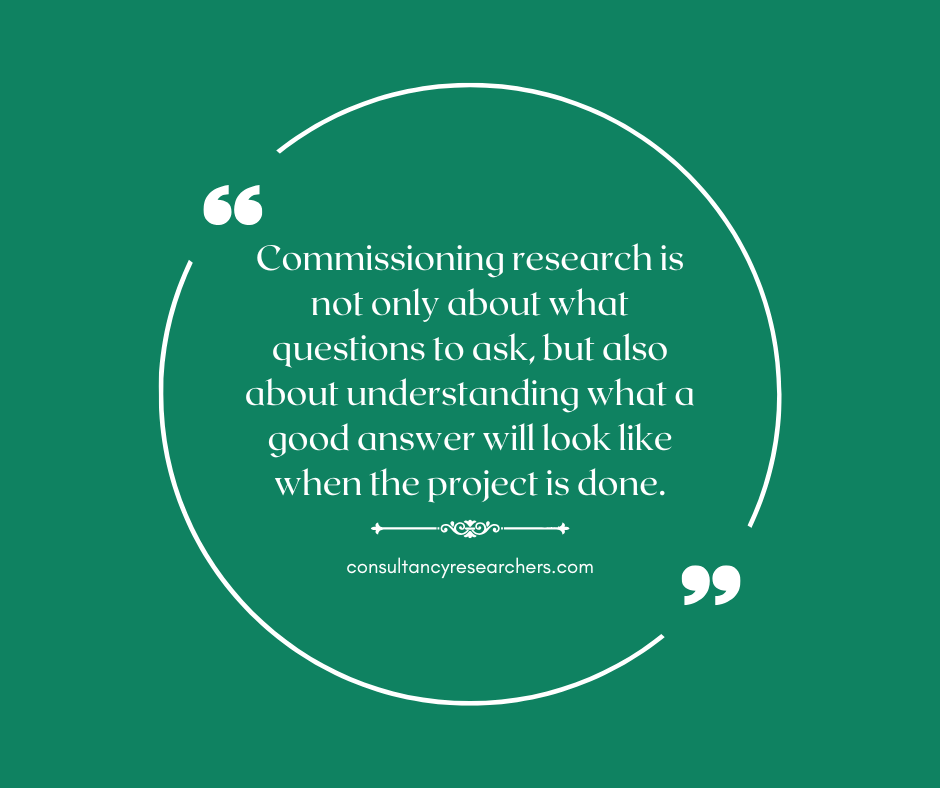
Commissioning research is not only about what questions to ask, but also about understanding what a good answer will look like when the project is done. To avoid ending up with an unusable report, be explicit about the outputs you expect. Specify the format that will be most useful to your audience. Knowing the primary audience for the report is crucial. This will shape how the research team should deliver the information (Hudson, 2021).
For example, if the insights are just for you and a small team, an informal discussion might suffice. In such cases, even a detailed spreadsheet could be enough for your needs. However, if the research will inform the board of directors, you may need a concise, formal report. A slide deck with executive-level summaries is often appropriate for that audience. And if the findings need to be shared across the whole organisation, consider providing a shorter, visually engaging summary. An interactive presentation could also work well for a broad audience (Hudson, 2021). Communicate these needs to the researchers upfront so they can tailor the deliverables accordingly.
Next, define the format and level of detail that you consider ideal. Clarify whether you prefer a written report with full documentation or a slide deck of key findings – or both. Describe if you want an executive summary or a set of recommendations as part of the output. Some business managers also request a one-page highlights sheet in addition to the main report. This way, busy stakeholders can grasp the conclusions at a glance.
If your company has any specific preferences or standards, make these clear to the agency. For instance, you may require the use of British English, certain branding on slides, or specific terminology. Also, be sure to specify if you would like any interim outputs before the final deliverable. For example, you might request a preliminary top-line report or a draft version for feedback. Providing feedback on a draft can help ensure that the final report meets your expectations. This step also allows any misunderstandings to be corrected in time.
In describing what “good” looks like, consider the qualities of a report that truly help you make decisions confidently. Apart from format and audience fit, actionability is key. An effective research report should not only present data but also interpret it in the context of your business question. It should highlight the insights that answer your core questions. Where appropriate, it should also offer implications or recommendations for your next steps.
Make it known to the researchers that you value clear conclusions over excessive jargon. You also prefer actionable recommendations over raw data dumps. When researchers know that you expect practical insights, they are more likely to frame their analysis accordingly. Ultimately, defining success criteria at the start helps ensure the final insights are relevant and ready to use. If done well, this process will leave you with a research report that directly addresses your business question and supports your decision-making. It certainly beats ending up with a glossy document that merely gathers dust (FieldworkHub, 2025).
References and further reading:
- Australian Survey Research (2021). Writing a research brief. Australian Survey Research Group. Available at: https://aussurveys.com/how-to-write-a-research-brief/ (Accessed 4 January 2026).
- FieldworkHub (2025). How to write a research brief that gets results. FieldworkHub Blog, 16 October 2025. Available at: https://fieldworkhub.com/resources/blog/how-to-write-a-research-brief-that-gets-results/ (Accessed 4 January 2026).
- Hudson, P. (2021). A Practical Guide to Translating Business Problems into Research Objectives. FlexMR Blog. Available at: https://blog.flexmr.net/business-problems-into-research-objectives (Accessed 4 January 2026).
- IFF Research (2026). How to write an effective research brief. IFF Research. Available at: https://www.iffresearch.com/resources/how-to-write-an-effective-research-brief/ (Accessed 4 January 2026).
